

The Culling Game arc is here — and it's either the smartest shonen in years or a law exam disguised as anime. We break it all down.
|
It Feels Like a Law Exam |
That Complexity IS the Point |
|
The Culling Game swaps emotional horror for a Battle Royale with a complex legal system. Fast-moving rule screens make it hard to follow, jarring for fans who prefer simple action. |
The rule system forces characters to use strategy ("outthink") rather than just brute force ("overpower"). The complexity pays off in strategic, courtroom-drama-like fights, enhanced by MAPPA's animation. 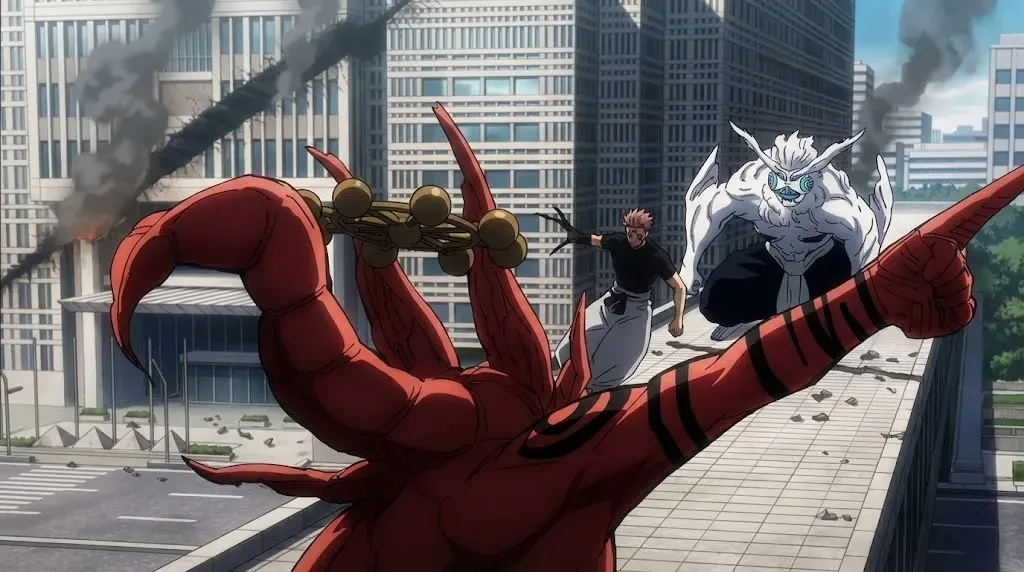 Also ReadSukuna's World-Cutting Slash Explained Also ReadSukuna's World-Cutting Slash Explained
|
 Also ReadThe Mahoraga Ritual Rules Explained
Why the Culling Game Divides the Community

The Shibuya Incident was survival horror. One location. Escalating dread. Emotional devastation that didn't require a rulebook — just eyes and a functional heart. The Culling Game is structurally the opposite. It is a dispersed, colony-based Battle Royale governed by a legal framework that the show introduces rapidly and expects you to retain.
The adaptation's biggest early stumble was pacing the exposition. In the opening episodes of Season 3, the rules appeared as dense text screens delivered fast enough to require multiple pauses. For viewers who came in expecting Shibuya 2.0, those opening episodes felt like someone handed them a terms-of-service agreement before the action started.
But here is the thing about the backlash: almost all of it is front-loaded. Once the rules land and the colonies open up, Season 3 delivers fights that Shibuya — for all its emotional devastation — simply couldn't. Because the rules are what make the fights interesting. They transform combat from a power-level contest into a problem-solving exercise where the smartest move beats the strongest one.
|
Feature |
Shibuya Incident |
Culling Game |
|
Structure |
Single location, escalating convergence |
10 dispersed colonies, parallel action |
|
Tone |
Survival horror, emotional devastation |
Strategic thriller, intellectual tension |
|
Entry Barrier |
Low — all stakes are immediately felt |
High — rules must click before payoffs land |
|
Fight Type |
Desperate brawls under impossible odds |
Creative 1v1s where the smartest player wins |
|
New Characters |
Minimal — spotlight on established cast |
Major — Hakari, Higuruma, colony fighters |
|
MAPPA Flex |
Gojo sequence, Mahito transformation |
Sendai Colony fights, Yuta vs. Yuji |
Why Season 3 Is Still Peak Shonen
Three things make Season 3 exceptional despite the learning curve — and each one is stronger than anything the arc's detractors tend to acknowledge.
The Animation Is Genuinely Cinematic
MAPPA has had their budget discourse. Season 3 ends it. The Sendai Colony sequences represent some of the finest action animation the studio has ever produced — fluid, dynamic, and structured around the unique spatial logic of domain expansions in a way that previous seasons only hinted at. The Yuta vs. Yuji sequence specifically has been described by multiple community voices as the best-animated fight in JJK history, which is a genuinely difficult bar to clear after Shibuya. MAPPA clears it.
The New Characters Are Immediate Legends

Hakari and Higuruma are not side characters. They are the arc's second and third leads, and both deliver techniques that are mechanically unlike anything previously shown in the series. Hakari's pachinko-jackpot domain is chaotic fun with genuine strategic stakes. Higuruma's courtroom domain is the single best argument for why the Culling Game's rule-complexity works — it turns a physical fight into a legal proceeding where the opponent's actual crimes determine the sentence.
Strategy Replaces Raw Power
The Culling Game's rule system eliminates the "scream louder and punch harder" resolution that plagues generic shonen arcs. Every fight is a puzzle. Every victory requires the winner to understand both their own technique and their opponent's technique well enough to construct a scenario the opponent cannot escape. It is the closest JJK has ever come to Hunter x Hunter's Nen system in terms of intellectual combat depth — and in Season 3, it consistently delivers.
|
Title |
Jackpot Domain Fighter |
Courtroom Domain Sorcerer |
|
Character |
Hakari Kinji |
Higuruma Hiromi |
|
Cursed Technique / Domain Expansion |
Cursed Technique: Idle Death Gamble |
Domain Expansion: Deadly Sentencing |
|
Description |
A pachinko-style domain that, upon hitting a "jackpot," floods Hakari with unlimited reversed cursed energy — making him effectively immortal for the jackpot window. Chaotic, dangerous, and one of the most visually inventive techniques in the series. The jackpot mechanic means Hakari fights differently every time, preventing any opponent from preparing a consistent counter-strategy. |
Transforms combat into a literal courtroom. A shikigami called Judgeman prosecutes the opponent for their real-world crimes. The most severe verdict — Extermination — strips the opponent of their cursed technique entirely. If the opponent is found innocent or Judgeman cannot identify a crime, the domain deactivates. A former defense lawyer weaponizing the law itself. Perfect storytelling. |
THE CULLING GAME — OFFICIAL RULES
Established by Kenjaku · Enforced by Kogane (Game Master) · 10 Colonies across Japan

|
A nation-wide death match across 10 barrier colonies in Japan. You kill people to earn points. You spend points to change the rules of the game itself. |
||
|
01 |
The Deadline |
Once a cursed technique awakens, a player has 19 days to join a colony. The clock starts instantly, with no extensions. |
|
02 |
The Penalty |
Failure to join a colony within 19 days results in the forcible removal of the cursed technique, which is fatal for sorcerers. |
|
03 |
No Bystanders |
Any normal human who enters a colony barrier is automatically classified as a player and can be legally killed for points. |
|
04 |
Point Scoring |
Killing a Sorcerer earns 5 pts. Killing a Non-Sorcerer earns 1 pt. |
|
05 |
The Reward |
Accumulate 100 points to request that Kogane (the Game Master) add a new rule to the Culling Game. |
|
06 |
The Catch |
Players can only add new rules, never remove existing ones. Proposed rules cannot fundamentally break the game structure. |
|
07 |
Anti-Camping Rule |
If a player's score does not increase for 19 days, they are automatically killed, preventing survival through hiding. |
Conclusion
Jujutsu Kaisen Season 3 is not for passive viewers. It demands your full attention during exposition, your patience during setup, and your trust that the complexity is going somewhere worth the confusion. For viewers willing to meet it halfway, the payoffs are extraordinary.
MAPPA's animation delivers its best work yet. Hakari and Higuruma are instant classics. The strategic depth of the Culling Game produces fights that will be discussed for years — not because of how hard the characters hit, but because of how cleverly they think. The one-point deduction goes to those early rule-dump episodes that could have introduced the system more gradually without losing any of the urgency.
Is it too confusing? Yes — if you're not paying attention. But that's exactly the point. The Culling Game rewards the audience that shows up for it.
|
Category |
Point |
Detail |
|
Strengths |
Exceptional Animation |
MAPPA's work, particularly during the arc's climax, is a highlight. |
|
Strengths |
Compelling Characters |
Hakari quickly emerged as a fan favorite. |
|
Strengths |
Creative Conflict |
Higuruma's courtroom domain and the emphasis on strategy over brute strength offered unique battles. |
|
Strengths |
Dynamic Presentation |
The fight choreography and cinematics in the Sendai Colony were impressive, and the arc delivered a variety of unique 1v1 matchups. |
|
Weaknesses |
Pacing and Exposition |
The arc suffers from a heavy initial load of rule explanations. |
|
Weaknesses |
Tonal Shift |
The change in tone following the Shibuya Incident arc can be jarring. |
|
Weaknesses |
Structural Issues |
The "Colony" setting sometimes makes the narrative feel disjointed or scattered. |








format(webp))













// Comments