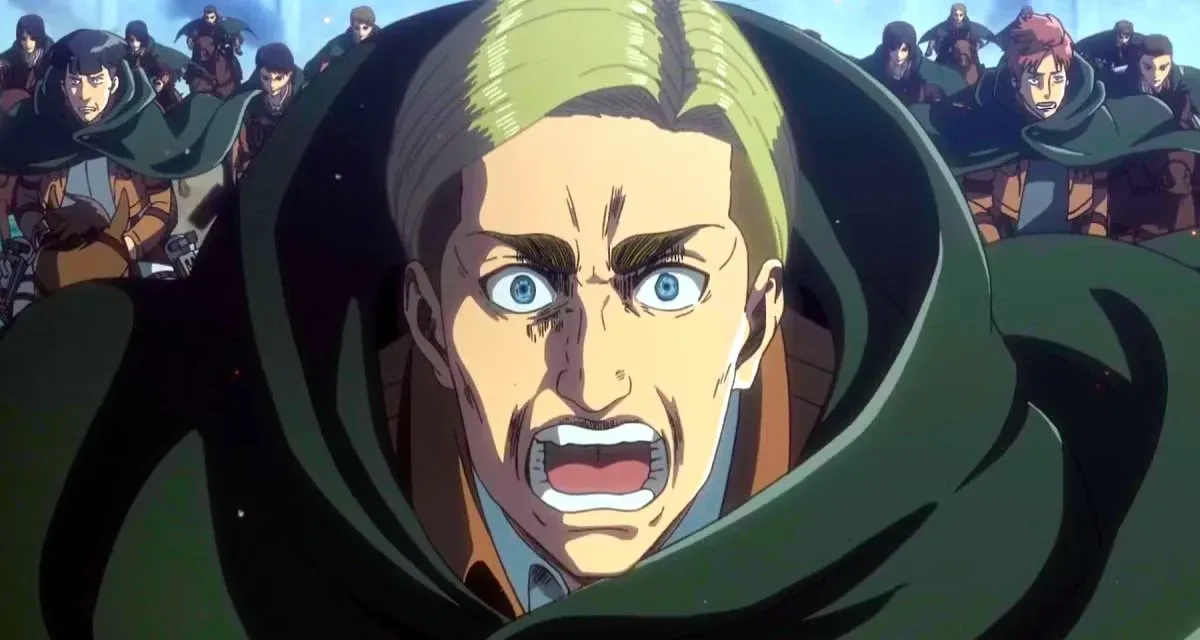
Introduction: The Devil of Paradis
In Attack on Titan, hope is a rare commodity, often bought with blood. No character understood this exchange rate better than Commander Erwin Smith. He was a man who sent thousands to their deaths with a stoic face, earning him the title of a "devil" among his own people.
However, his final act—the suicide charge against the Beast Titan in Shiganshina—stands as the definitive moment of leadership in the series. It was not a battle strategy; it was a psychological masterpiece where a man convinced terrified teenagers to run straight into hell, not for victory, but for meaning.
1. The Burden of the Basement (The Selfish Dream)
To understand the weight of the charge, one must understand Erwin’s guilt. For years, he claimed to fight for humanity, but deep down, he was driven by a selfish childhood curiosity: he wanted to see what was in Eren Yeager's basement and prove his father’s theories right.
As the Beast Titan pinned them down with a barrage of crushed rocks, Erwin was mere miles from achieving his life's goal. He had to make a choice:
 Also ReadMost Viewed Anime of All Time?
- The Dream: Abandon his soldiers, hide, and finally see the truth of the world.
- The Duty: Die here, sight unseen, so that humanity (Levi) might have a sliver of a chance to win.
His decision to "give up on his dreams and die" is a heartbreaking rejection of his own humanity for the sake of the collective.
2. The Speech: "My Soldiers, Rage!"
Erwin’s final speech is perhaps the most iconic monologue in modern anime. He does not lie to his soldiers. He does not promise them glory or survival. He looks them in the eye and tells them they will die meaningless deaths.
"Does that mean our lives are meaningless? No! It is us who gives meaning to our comrades' lives! The brave fallen! The anguished fallen! The ones who will remember them... are us, the living!"
He reframes death not as an end, but as a passing of the torch. He convinces them that the only way to rebel against the cruelty of the world is to die fighting, trusting that the living will carry their memory forward.
 Also ReadMikasa Ackerman's Fate: What Happened After the Final War?
3. The Charge: A Gamble on Levi
The strategy was simple and horrific. The Beast Titan was decimating them from a distance. The only way to close the gap was a distraction. Erwin used himself and the new recruits as bait—a smoke screen of human bodies—to draw the Beast Titan's attention while Captain Levi flanked from the side.
- The Visuals: The animation of the charge is brutal. There is no glorious music, only the terrifying sound of wind and the sickening impact of rocks turning humans into mist.
- The Impact: Erwin is struck in the waist almost immediately, yet he continues to scream commands until he falls. He doesn't die as a hero in a duel; he dies as one of the many, just another body in the pile he built.
4. The Aftermath: The Choice of Serum
The tragedy of Erwin Smith extends beyond the charge. Though mortally wounded, he is brought back to the walls by Floch, presenting Levi with an impossible choice: use the Titan serum to save Erwin (logic) or Armin (hope).
Levi’s decision to let Erwin die was an act of mercy. He realized that bringing Erwin back would be cruel—it would force him to return to the "hell" of leadership. By letting him pass, Levi allowed the Commander to finally rest, free from the burden of his mountain of corpses.
Conclusion
Erwin Smith’s final charge is a masterclass in writing because it redefines what it means to win. He didn't live to see the ocean. He didn't see the basement. But by giving his heart, he ensured that humanity would live long enough to find the truth. He proved that sometimes, the most important move in the game is to sacrifice the King so the Pawns can checkmate.




















// Comments