In the pantheon of unique weapon–user bonds in One Piece — from Mihawk's Yoru to Zoro's Wado Ichimonji — none carries the mythological weight of Prince Loki and Ragnir. Ragnir is not simply a weapon. It is a centuries-old guardian, a sentient being with its own Devil Fruit, and the living embodiment of a Norse mythological role that makes Loki's own fruit complete. Chapter 1174 brought their partnership into full, breathtaking view. This article unpacks every layer: Ragnir's identity, its Zoan fruit, the elemental techniques it enables, its mythological blueprint, and why this "two Devil Fruit" loophole is one of the most creative power systems Oda has ever designed.
Ragnir: The Sentient Iron Thunder — Full Profile
Before examining the synergy with Loki's fruit, it is worth establishing exactly what Ragnir is as a standalone entity — because its individual depth is what makes the partnership extraordinary rather than merely convenient.
Official Name
Ragnir — translated as "Iron Thunder"
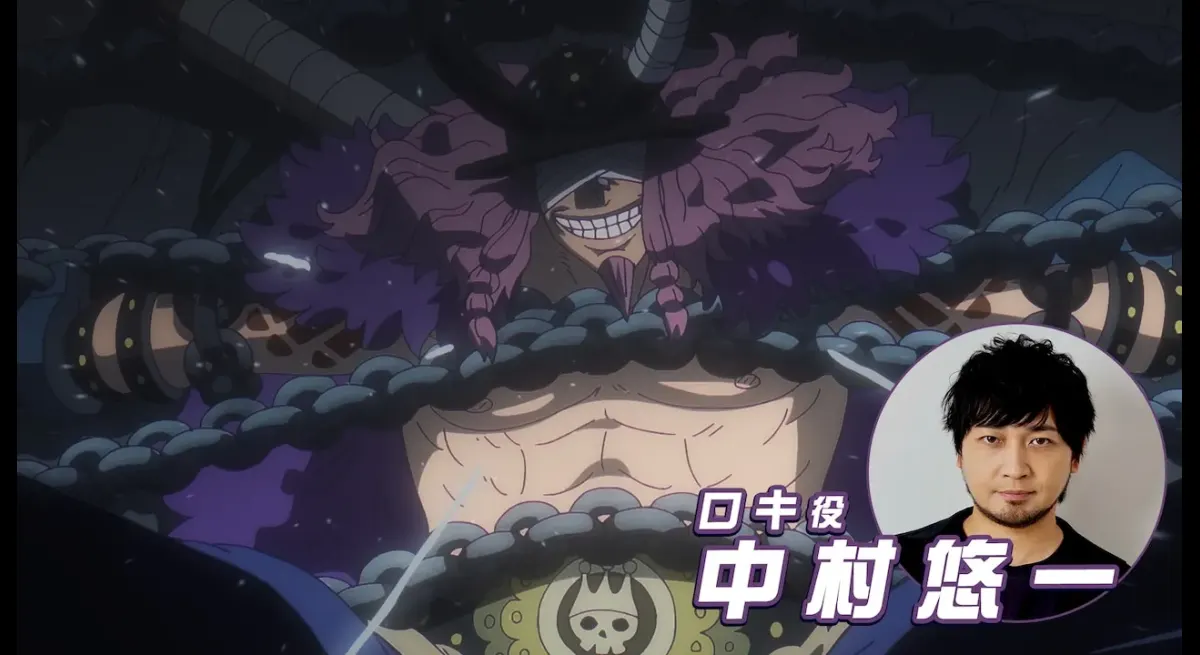 Also ReadYuichi Nakamura as Loki in "ONE PIECE": Elbaf Edition OP by Aina The End
Weapon Type
Colossal warhammer; proportioned for giant-scale combat
Devil Fruit Type
Zoan — transforms into a giant squirrel and squirrel-hammer hybrid form
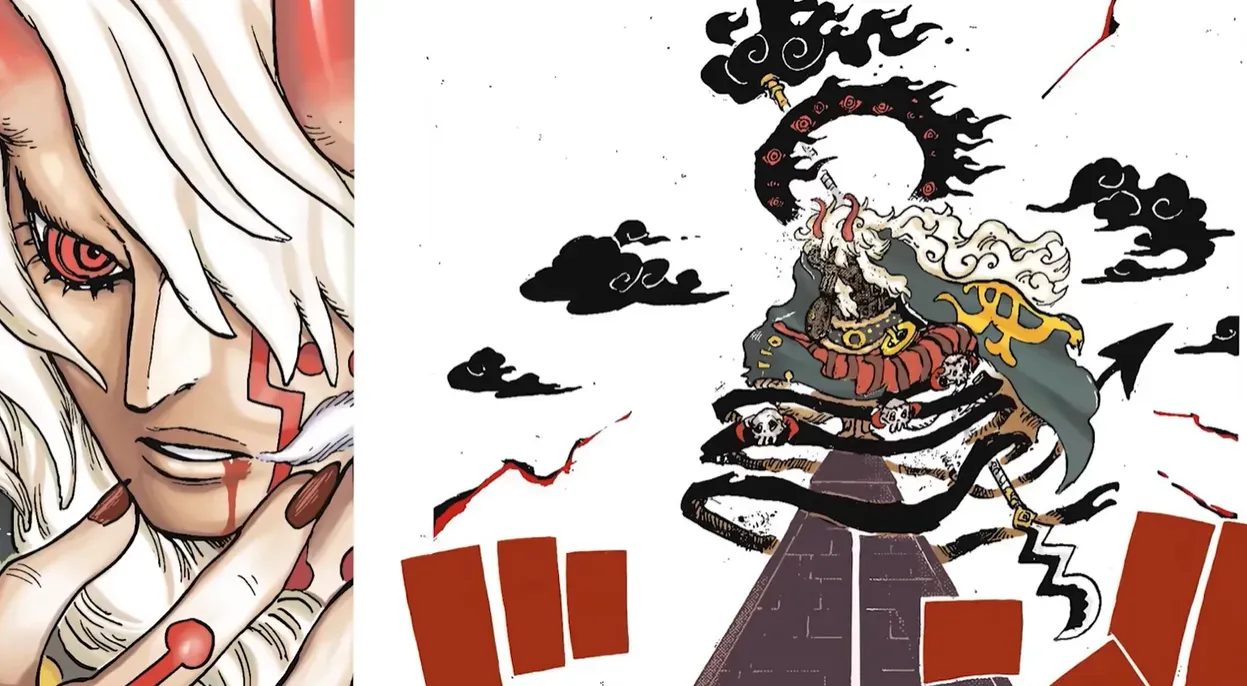 Also ReadOne Piece Chapter 1180 "Omen" Spoilers: Imu's God-Like Power Destroys Zoro & Sanji
Mythological Model
Ratatoskr — the messenger squirrel of Norse myth, dweller of Yggdrasil
Guardian Role
Gatekeeper of Elbaf's National Treasure Devil Fruit for hundreds of years
Bond Established
14 years before current story, after Loki defeated Ragnir in combat
Combat Role in Partnership
Both elemental conduit (lightning, ice) and independent fighter; Ragnir can act autonomously without Loki directing it, making it effective in chaotic multi-front battles where Loki's attention is split across his dragon form.
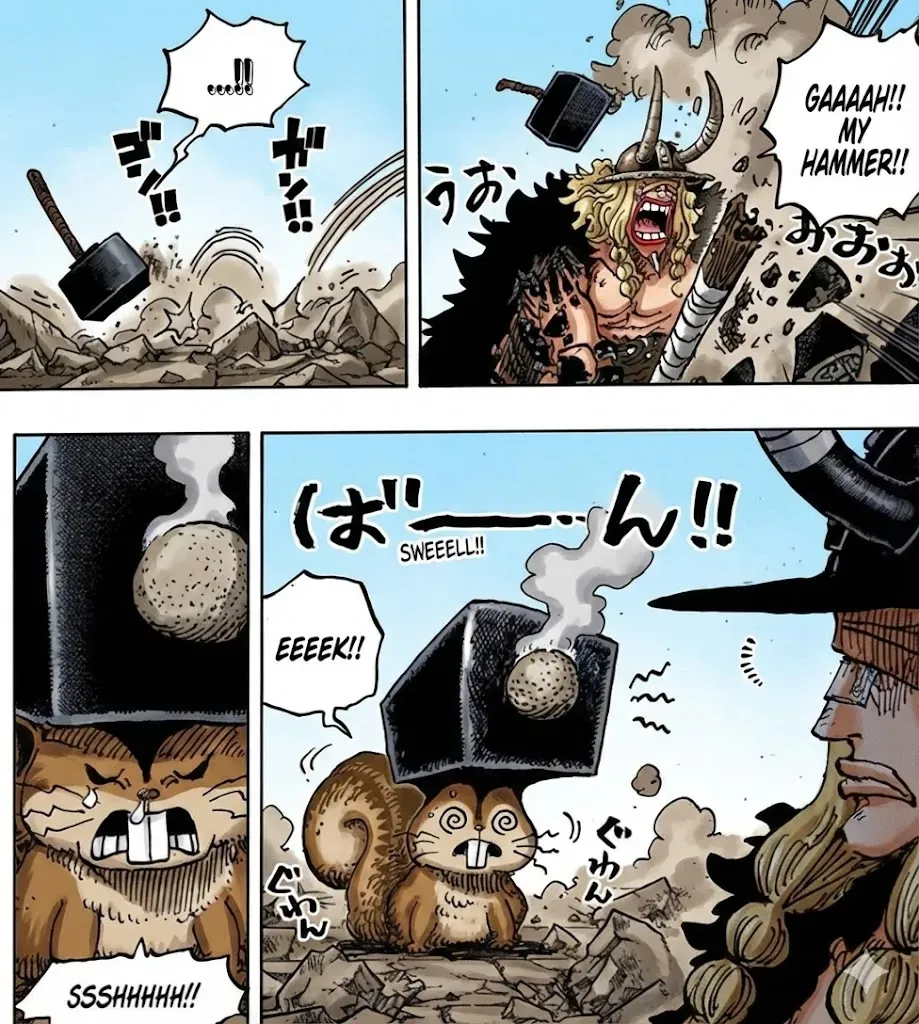
The precedent for inanimate objects consuming Devil Fruits exists in One Piece — Funkfreed (the elephant sword), Spandam's carpet, and the various Pacifista upgrades all demonstrate this. But Ragnir is unique even among these: its Zoan form is drawn from a specific, narratively significant mythological creature rather than a generic animal, and its centuries of existence as a guardian predate its bond with any human. Ragnir chose Loki — not the other way around.
The Elemental Techniques: Lightning & the Niflheim Technique
The most immediately impactful aspect of the Loki–Ragnir partnership is how it expands Loki's combat toolkit. Despite possessing a Mythical Zoan dragon form (Model: Nidhoggr) capable of catastrophic destruction on its own, Loki channels his two most iconic attacks through Ragnir rather than his own body. This creates a layered power system where weapon and wielder are tactically inseparable.
Lightning Summoning
By driving Ragnir into a surface — the ground, an enemy, the sea floor — Loki summons massive lightning strikes from the sky onto the impact point. Unlike standard lightning devil fruits that generate electricity internally, this technique calls down actual atmospheric lightning, giving it a scale that dwarfs conventional electrical attacks. The hammer acts as a conductor and amplifier simultaneously, with Ragnir's squirrel Zoan nature theorized to channel the electrical charge through its own body as part of the strike. The visual parallel to Thor's hammer Mjolnir is intentional — Oda layers Norse references so that Ragnir occupies both the Ratatoskr and Mjolnir roles within the mythology simultaneously.
Niflheim — The Primordial World
Named after Niflheim — the primordial realm of ice, mist, and cold in Norse cosmology, one of the two original worlds from which all creation emerged — this technique uses Ragnir to instantly flash-freeze targets solid. The freezing is not gradual; it is absolute and immediate, encasing enemies in ice on contact with Ragnir's strike. The naming choice is deliberately cosmological: Niflheim in Norse myth predates the gods themselves, making it the oldest cold in existence. Oda uses this name to signal that Ragnir's ice technique is not simply cold — it is primal, world-order-level cold. Paired with Loki's Nidhoggr dragon form (which itself heralds Ragnarok), the Niflheim technique reinforces that Loki wields forces of world-ending mythology rather than conventional elemental power.
Why Channel Through Ragnir Rather Than His Dragon Form?
A frequently asked question is why Loki uses Ragnir as the medium for these attacks rather than deploying them directly from his Nidhoggr form. The most compelling theory: Loki's dragon body generates raw, unfocused destruction — described in Chapter 1174 as a "natural disaster in physical manifestation." Ragnir acts as a precision instrument, focusing that catastrophic energy into targeted strikes. Without Ragnir, Loki cannot distinguish between enemy and ally in his most destructive state. With Ragnir, the destruction has direction. The squirrel, in this sense, is not just a weapon — it is Loki's self-control made physical.
The Norse Mythological Blueprint: Ratatoskr, Nidhoggr & Yggdrasil
No analysis of Ragnir and Loki's partnership is complete without understanding the Norse mythological system Oda is drawing from. The relationship between Ratatoskr and Nidhoggr in the original myths is not incidental — it is a cosmological necessity, and Oda has transplanted that necessity directly into One Piece.
|
Mythological Element |
Norse Original |
One Piece Counterpart |
|
The Great Tree |
Yggdrasil — the World Ash Tree connecting all nine realms; its roots reach into Niflheim, its crown into Asgard |
The Adam Tree / World Tree of Elbaf; its imagery appears in the Chapter 1138 mural showing a dragon descending toward its roots |
|
The Dragon at the Roots |
Nidhoggr — the corpse-gnawer who eternally chews the roots of Yggdrasil, slowly destroying the foundation of the world toward Ragnarok |
Loki's Mythical Zoan — Model: Nidhoggr; his black dragon form represents entropy and world-ending destruction |
|
The Messenger Squirrel |
Ratatoskr — the squirrel who runs up and down Yggdrasil's trunk carrying messages (often malicious ones) between Nidhoggr below and the eagle above |
Ragnir — the sentient squirrel-hammer who perches atop Loki's head in dragon form; the connector between the "dragon below" and the world above |
|
The Eagle at the Crown |
An unnamed eagle (with the hawk Veðrfölnir between its eyes) perched at Yggdrasil's crown, representing watchfulness and aerial dominion |
Theorized to correspond to Luffy / Sun God Nika as the "sky presence" in the mythological triad — the force at the top that Ragnir connects to Loki |
|
Ratatoskr's Function |
Not merely a messenger but a stirrer of conflict — Ratatoskr carries provocative words to escalate tension between Nidhoggr and the eagle, implying the squirrel has its own agenda |
Ragnir's independent will and its centuries of rejecting all warriors (until Loki) mirrors Ratatoskr's selective, agenda-driven nature — it chose its role rather than being assigned it |
|
The Cosmological Completion |
Nidhoggr and Ratatoskr require each other to fulfill their roles — neither the roots nor the crown have meaning without the messenger running between them |
Loki as Nidhoggr without Ragnir is raw, directionless catastrophe; Ragnir without Loki is a guardian with no ward. Together they complete the mythological cycle — dragon + squirrel = the World Tree system made manifest |
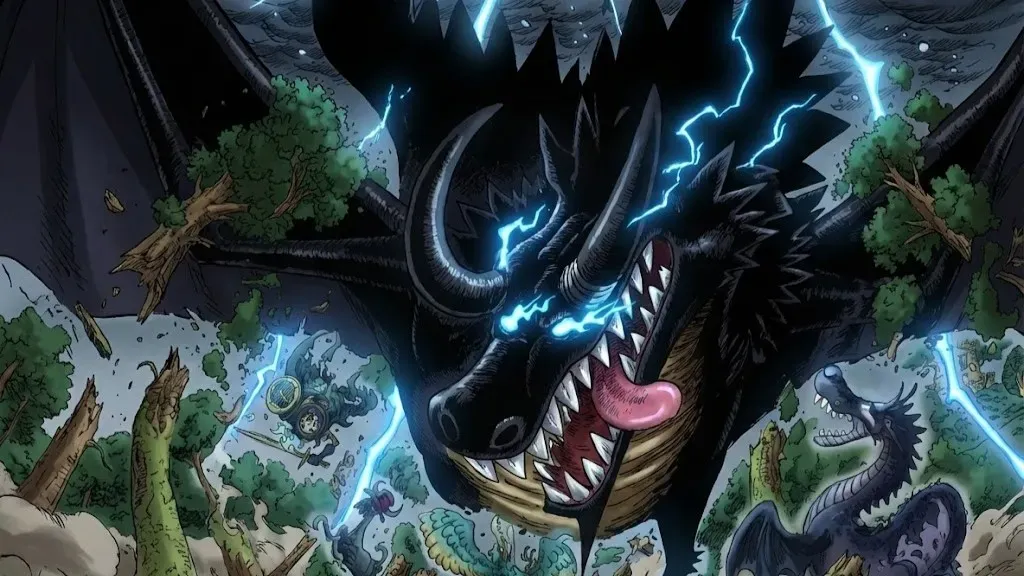
The most visually stunning confirmation of this mythological mapping comes in Chapter 1174 itself: as Loki transforms into his colossal black dragon form, Ragnir shifts to its squirrel form and perches directly on top of Loki's head. This is not aesthetic coincidence. It is Oda physically recreating the Yggdrasil axis — the dragon at the base, the squirrel traveling upward — compressed into a single image of one character carrying another.
The "Two Devil Fruit" Loophole — How It Works
One of One Piece's most firmly established rules is that a single living being cannot consume two Devil Fruits without their body being destroyed by the conflicting powers. Blackbeard's ability to break this rule is treated as one of the series' greatest mysteries. Yet Loki effectively wields two Devil Fruit power sets without violating this rule — and the mechanism is elegant in its simplicity.
Loki’s power is framed as a Mythical Zoan tied to the model Nidhoggr, giving him a dragon-like body that feels less like flesh and more like living entropy. Alongside this sits Ragnir, a Zoan squirrel that exists as a separate entity, acting as a lightning and ice conduit. Together they form a complete mythological system rather than two clashing abilities. The result is the sense of dual fruit powers operating in harmony with zero fatal conflict, symbolizing a full Norse cycle embodied in one character.
The key is that Ragnir is a separate, independent entity. It is not Loki's body consuming a second fruit — it is a distinct being, a weapon with its own will, that consumed its own fruit independently over its centuries of existence. One Piece has established this precedent clearly: Funkfreed the elephant sword is a separate being from its wielder Spandam; the two fruits (Funkfreed's elephant Zoan and any fruit Spandam might consume) would not interact fatally because they belong to different physical entities.
The partnership therefore operates as follows: Loki's Nidhoggr fruit governs his dragon transformation and his own body's capabilities. Ragnir's Zoan fruit governs Ragnir's squirrel transformation and its independent movement. When Loki wields Ragnir to summon lightning or execute the Niflheim technique, he is not using his own fruit to generate those effects — he is directing Ragnir (who generates them) using his own will and Haki. Two entities, two fruits, one coordinated power system. The partnership is a loophole within the rules, not a violation of them.
Narrative Precedent in One Piece
This is not the first time One Piece has explored the idea of a weapon with its own Devil Fruit expanding its wielder's effective power. However, Loki and Ragnir represent the most sophisticated version of this concept: where previous examples (Funkfreed, etc.) added a single transformation gimmick, Ragnir adds two distinct elemental techniques, autonomous combat capability, and a mythologically coherent reason for the bond to exist. It is the difference between a weapon that happens to have a fruit and a weapon whose fruit was cosmologically destined for its role.
Chapter 1174: The Partnership in Action
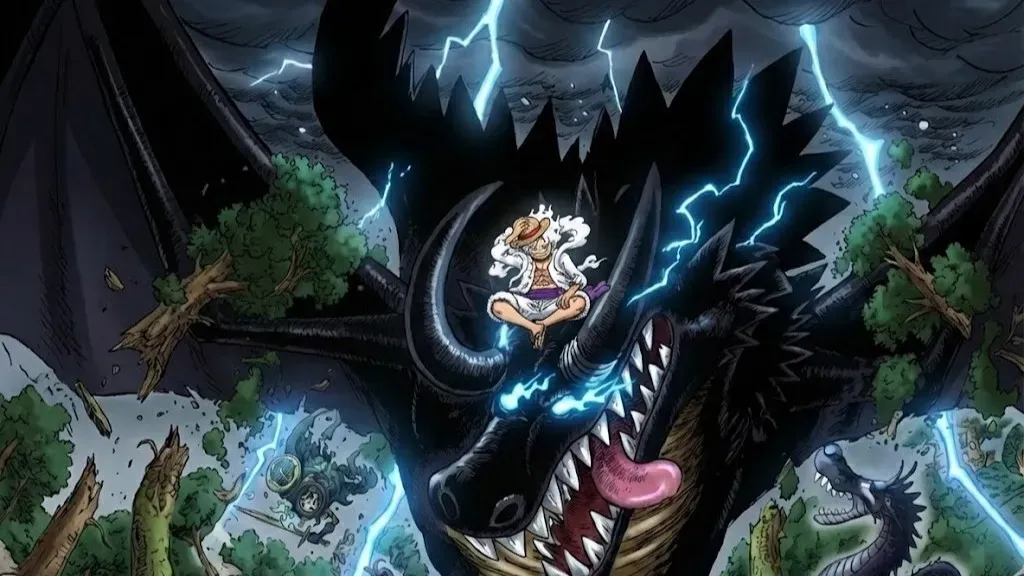
Chapter 1174, titled "The Strongest Thing in the World," represents the most complete display of the Loki–Ragnir dynamic the series has shown to date. Every element of their established lore culminates in the chapter's final sequence.
The Dragon Transformation
Loki activates his Mythical Zoan, becoming a colossal black dragon described as "absurdly massive" — the Nidhoggr form that commands both lightning and snow. The sheer scale of the transformation dwarfs everything in the immediate environment, making coordinated combat against him nearly impossible for normal opponents.
Ragnir's Position — The Mythological Image
Rather than being dropped or stored, Ragnir shifts to its squirrel form and perches atop Loki's massive dragon head. This single image quietly completes the entire Norse mythological mapping: the squirrel (Ratatoskr) riding the dragon (Nidhoggr), the connection between root and crown, weapon and wielder, chaos and direction — all expressed in one panel.
The Motive: Saving the Children
The transformation is triggered by Loki's choice to protect the giant children — a decision at direct odds with his own declared identity as "a destroyer, not a savior." Ragnir does not resist or question this choice; the guardian that spent centuries protecting Elbaf's treasures recognizes the protective impulse in Loki even when Loki himself refuses to name it that way.
The Charge — Alongside Gear 5 Luffy
The chapter closes with Loki (in dragon form, Ragnir perched above) charging the MMA Monsters side-by-side with a Gear 5 Luffy. The alliance of Sun God Nika and the Nidhoggr dragon — the mythological opposite forces of creation and destruction — suggests Oda is building toward something cosmologically significant for both characters.
The World Tree Made Flesh: Why This Partnership Matters
In a series defined by creative devil fruit concepts and memorable weapon–user bonds, Loki and Ragnir represent something genuinely unprecedented: a partnership where the mythological logic is not just decorative but structurally necessary. Remove Ratatoskr from Yggdrasil and Nidhoggr becomes an isolated force with no connection to the world above it. Remove Ragnir from Loki and his dragon form becomes an undirected catastrophe — power without purpose, destruction without distinction.
Together, they form a complete cosmological system. The squirrel gives the dragon direction. The dragon gives the squirrel scale. Their bond is 14 years old, tested in combat, and mythologically inevitable. And Chapter 1174 made clear that Oda has been building toward this image — a black dragon charging into battle with a squirrel on its head — since the moment Elbaf's World Tree first appeared in the story. The strongest thing in the world, it turns out, is a partnership written into the mythology of the world itself.




// Comments